SHUNAFFoZ (Festival) 2012
- 1
- 2






Filming Through Zambia’s Rainy Season
Zambia’s rainy season can transform a film location within minutes. From roughly November to April, clear skies may give way to intense showers, electrical storms and fast-moving floodwater. Roads become slippery, red earth turns to deep mud, and a carefully planned shooting day can be disrupted before the first take.
Yet the wet season also gives filmmakers striking visual possibilities. Landscapes become greener, rivers swell, wildlife gathers around water, and communities experience a distinct rhythm of work, travel and celebration. For a production team, the season is both a practical test and a creative opportunity.
Vilole Images Productions works across film development, pre-production, production and post-production in Zambia, with experience grounded in local realities. Its film production work reflects the value of planning stories around the people, places and conditions where they are made.
Australian filmmakers will recognise some familiar production pressures. A crew shooting in Darwin or Far North Queensland understands the meaning of “the wet”, while teams in Brisbane, Cairns or the Kimberley know that a Bureau of Meteorology warning can alter a schedule quickly. Zambia’s rainy months demand the same level of preparation, adapted to local roads, power access and filming environments.
Weather that changes by the hour
Rain in Zambia is often highly localised. A location may be dry in the morning while a storm is building a few kilometres away. Heavy cloud can reduce available light, and a downpour may arrive with strong wind, thunder and lightning. Weather applications are useful, but they should be combined with local knowledge from location managers, drivers and community contacts.
A production should build flexible shooting blocks into the call sheet instead of treating every day as fixed. Exterior scenes can be grouped according to weather tolerance, while interiors, interviews, cutaways and sound recording are kept ready as alternatives. This approach resembles planning around wet-season storms in northern Australia, where a crew may shift from a beach sequence to an interior scene without losing the entire day.
Roads, transport and access
Many Zambian locations are reached through unsealed roads, rural tracks or routes that deteriorate rapidly under repeated rain. A vehicle that handled the journey comfortably in the dry season may struggle in deep mud or standing water. Bridges and culverts can become unsafe, and a short trip may take several hours when drivers need to reduce speed.
Transport planning should include suitable four-wheel-drive vehicles, recovery equipment, spare tyres, extra fuel and experienced local drivers. Essential equipment should travel in waterproof cases, while food, drinking water and basic medical supplies should be carried in case the crew is delayed. This is comparable to remote shoots in the Northern Territory, where distance, limited services and changing road conditions make self-sufficiency essential.
Protecting cameras and sound gear
Moisture is a constant threat during a wet-season shoot. Rain can enter camera bodies, lenses, recorders, radio microphones and batteries, while high humidity encourages condensation when equipment moves between cool vehicles and warm outdoor air. Mud and fine grit can damage tripods, cable connections and focus mechanisms.
Rain covers, dry bags, silica gel, absorbent cloths and resealable plastic containers should be part of the standard kit. Cameras need time to acclimatise before cases are opened in a humid environment. Batteries should be stored in protected, clearly labelled containers, and memory cards should be backed up at least twice each day whenever power and time allow.
Sound teams face particular difficulty because rain creates a broad, continuous noise floor. Even a light shower on a metal roof can overpower dialogue. A boom operator may need to work under protection, and lavalier microphones require careful placement beneath clothing without trapping moisture. Recording clean wild tracks after rainfall can help editors create a more convincing soundscape later.
Light, continuity and the visual plan
Cloud cover can produce beautiful soft light, but it can also change exposure and colour temperature between takes. A scene that begins in bright overcast conditions may finish under dense storm cloud. Wet surfaces create reflections, while puddles and runoff can alter the appearance of a location from one shot to the next.
The cinematographer and script supervisor should track the direction, intensity and duration of rainfall. Continuity photographs become especially important when actors, vehicles or props move through wet ground. Neutral density filters, diffusion materials and portable LED fixtures can help maintain consistency, though every item must be protected from water and secured against wind.
Rain can also become part of the story rather than a problem to hide. Reflections on a Lusaka street, water running through a village path or mist over a green valley may communicate mood and place more effectively than a controlled dry-season setup. The creative decision should be deliberate, with the crew agreeing whether rain is visible, implied or avoided.
People, health and daily logistics
A wet-season schedule affects everyone on set. Clothing takes longer to dry, footwear becomes uncomfortable, and long waits in rain can lead to fatigue. Mosquitoes and other insects may be more active, while muddy ground increases the risk of slips and minor injuries. Crews need sheltered rest areas, dry clothing options and clear hygiene arrangements.
Catering requires extra care because food storage and preparation become more difficult in damp conditions. Drinking water should remain available even when the weather is cool, and warm meals can help maintain energy during long delays. Local communities should be informed about altered access, noise, vehicles and filming times, particularly when storms make roads or footpaths harder to use.
For Australian producers, the comparison with a remote Queensland shoot is useful: welfare is part of production design, not an afterthought. A crew that feels rushed, cold or poorly briefed is more likely to make mistakes with equipment, safety and continuity.
Power, communications and location permissions
Storms can interrupt electricity, mobile coverage and internet access. A production should never assume that a location with reliable daytime power will remain connected during heavy rain. Charged power banks, spare batteries, surge protection and a generator or solar charging option may be necessary, particularly for rural documentary work.
Data management deserves a specific rainy-season procedure. Backups should be stored in separate waterproof containers, with one copy kept away from the main equipment area. If footage must be transferred over a weak connection, the team should use a clear file-naming system and maintain a written camera and sound log.
Permissions may also need seasonal review. A road, park, school or community venue can become inaccessible or unsafe after rain. Location agreements should identify alternative spaces and allow reasonable changes to the schedule. Early communication with local authorities and custodians can prevent a production from arriving at a site that is technically permitted but practically unusable.
Post-production begins on location
Good editing decisions depend on good material management in the field. Rain delays often compress the schedule, leaving less time for retakes, room tone and establishing shots. A disciplined assistant editor or data wrangler can protect the project by checking files, organising metadata and flagging missing coverage before the crew leaves a location.
Documentary teams working under pressure can learn from a Zambian editor’s insights into rapid cutting and decision-making. Reviewing selected rushes during production can reveal whether dialogue is clear, whether weather has damaged continuity and whether the story has enough transitions to survive an altered shooting plan.
Editors should also receive accurate notes about rain intensity, cloud cover, generator noise and unexpected events recorded in the background. These details help them match shots and design the soundtrack. A strong post-production workflow can turn an interrupted shoot into a coherent film, while poor labelling can make even excellent footage difficult to use.
Turning the wet season into a production advantage
The best response to Zambia’s rainy conditions is neither to ignore the season nor to treat it as an automatic obstacle. It is to design a production that can adjust without losing its purpose. Flexible call sheets, local partnerships, protected equipment, reliable transport and realistic crew welfare plans provide the foundation.
The season can offer images unavailable at other times of year: renewed farmland, dramatic skies, flowing streams, saturated colour and stories shaped by changing access to work, school and markets. For filmmakers from Australia, the lesson is familiar from working across the Top End and tropical Queensland: weather is part of the location, and the location is part of the story.
Producers planning a Zambian project can explore Vilole Images Productions for film services, completed works, industry news and information about the Shungu Namutitima International Film Festival of Zambia. Build a wet-season risk plan early, speak with local partners, and allow the rain to inform the filmmaking rather than dictate its limits.
SHUNAFFOZ 2016 Entry Form

Featured Articles
- 1
- 2


SHUNGU NAMUTITIMA INTERNATIONAL FILM FESTIVAL (SHUNAFFoZ) 2015
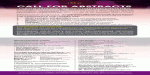
Vilole Images Productions is glad to invite filmmakers to submit documentaries, short films and full-length films to the Shungu Namutitima International Film Festival of Zambia (SHUNAFFoZ). The festival will run from Friday 21st to Saturday 29th August 2015 in Livingstone and from Wednesday 19th to Saturday 22nd August 2015 in Kabwe. Deadline for submissions is Monday 22nd June 2015. Celebrating the 10th Anniversary, under the theme ''DARE TO DREAM, MAKE A DIFFERENCE'', the festival will accept Zambian and African films in competition. However, films from all over the world are for screenings ONLY. the 10th Anniversary will introduce another special award - the Artists Rights Award.
Read more
SHUNGU NAMUTITIMA INTERNATIONAL FILM FESTIVAL (SHUNAFFoZ) 2015
Vilole Images Productions (VIP) is glad to invite filmmakers to submit docuentaries, short films and full-length feature films to the Shungu Namutitima (Smoke That Thunders) International Film Festival of Zambia (SHUNAFFoZ). The festival will run from Friday 21st to Saturday 29th August 2015 in LIVINGSTONE and from Wednesday 19th to Saturday 22nd August 2015 in KABWE. Deadline for submissions is Monday 22nd June 2015. Celebrating the 10th Anniversary, under the theme ''DARE TO DREAM, MAKE A DIFFERENCE'', the festival will accept Zambian and African films for competition. However, films from all over the world are for screening only. The 10th anniversary will introduce another special award - the Artists Rights Award
Read moreFeatured Video

Visitors Counter


|
Today | 128 |

|
Yesterday | 1858 |

|
This week | 1986 |

|
Last week | 10247 |

|
This month | 5326 |

|
Last month | 44630 |

|
All days | 626767 |
Your IP: 54.173.35.129
,
Today: Dec 04, 2017