SHUNAFFoZ (Festival) 2012
- 1
- 2




Building a Realistic Budget for Your Zambian Feature Film
Zambia has emerged as one of southern Africa's most compelling filming destinations, drawing producers from Sydney boardrooms, Melbourne production offices, and Perth indie studios who seek the country's golden landscapes, the bustle of Lusaka's streets, and lower cost baselines compared to Western shoots. Crafting a workable spending plan for a Zambian feature remains a specialised craft, one that blends local labour rates, currency realities, and the unpredictable rhythms of working across two continents.
Whether you are an Australian producer eyeing a co-production treaty, a returning Zambian filmmaker seeking tighter financial control, or a first-timer testing regional stories, the budgeting process deserves patience. Travel corridors between Johannesburg and Lusaka, fluctuating kwacha valuations against the Australian dollar, and Zambian tax considerations all shape the final figure. A thoughtful budget is less about slashing numbers than about knowing precisely where each dollar travels.
Researching the Local Production Landscape
Before a single line item is drafted, a producer needs hard data about what things actually cost in Zambia. Hotel rates in Lusaka's show district, catering prices near filming zones in Livingstone, and daily equipment hire at local rental houses each carry different price tags than Sydney or Cape Town standards. Many first-time producers overestimate what they can achieve for a given figure, often because they have only consulted international rate cards.
Spend at least two weeks on location scouting with a Zambian line producer who understands festival deadlines, union expectations, and seasonal weather shifts. The rainy season between November and April can quietly double transport and accommodation costs because rural roads wash out. Cross-reference every rate against at least two local suppliers, and keep notes about fuel levies, park entry fees for any shoots near national parks, and overtime rates that local crew typically expect.
Australian producers should also familiarise themselves with the Zambia film classification framework, since deliverables are reviewed by the Zambia Censorship Board before public exhibition. Build a small compliance buffer into the early budget so last-minute classification requests do not derail the schedule or empty the contingency line.
Building a Pre-Production Budget That Holds Together
Pre-production is the section of the budget where savings often evaporate. Time spent locking a script, casting actors, scouting locations, hiring a Zambian line producer, and arranging permits all consumes cash months before the camera rolls. A well-written synopsis might seem like a creative step, but it is the financial anchor that determines who invests, who grants funding, and how much can be raised. The piece on writing a synopsis explains how the document frames the entire financial story.
Casting costs vary widely. Working with the Zambian Actors Guild gives clarity on union rates, while engaging emerging talent from the University of Zambia's theatre programme can offer substantial savings in exchange for stronger backend credits. Allow between eight and fourteen weeks for casting, depending on the number of speaking roles, and budget not only the actor fees but also wardrobe fittings, callbacks, and possible travel from regional towns.
Permits and location agreements deserve separate attention. Filming in tourist areas such as Victoria Falls requires coordination with municipal councils and sometimes tribal authorities in Southern Province. Include line items for council fees, security arrangements, insurance riders, and the often-overlooked cost of restoring any venue to its original condition after wrap.
Accounting for Production Week Realities
The actual shoot is where most budgets either survive or fail. Crew salaries, equipment hire, transport between locations, catering, art department, makeup, costume, and on-set insurance form the spine of this section. A Zambian feature typically schedules between eighteen and thirty shooting days, depending on complexity, and each day carries fixed costs that cannot be pushed much lower without affecting cast morale.
Australian producers accustomed to the country's strict workplace health and safety legislation should note that Zambia has its own frameworks administered through the Ministry of Labour. Long shifts are common practice, but producers carry an obligation to provide meals, drinking water, transport home, and adequate rest. Skimping on these basics often results in crew illness that can shut down an entire day, which is far more expensive than providing proper support in the first place.
When writing dialogue in local languages, producers should budget generously for dialect coaches, translators, and additional rehearsal time. Filming in Bemba, Nyanja, or Tonga is increasingly common, and the article on crafting screen dialogue for Zambian languages offers specific guidance on how linguistic authenticity affects scheduling and rehearsal budgets.
Post-Production, Distribution, and Festival Costs
Post-production is the area where Australian producers tend to underestimate timelines. Editing suites in Lusaka are improving, yet many productions still send footage to Cape Town or, increasingly, back to post houses in Melbourne and Sydney for colour grading and sound mixing. Shipping hard drives, paying international editors by the hour, and licensing music from international catalogues each contribute to a figure that often balloons by twenty per cent above initial estimates.
Subtitling, dubbing, and accessibility features add further layers. If the film targets both domestic Zambian audiences and international festivals, multiple subtitle versions and descriptive audio tracks become essential. Festival submission fees to Cannes, Toronto, and Brisbane's Asia Pacific Screen Awards stack up quickly, as do travel costs for directors attending premieres abroad.
Distribution costs vary by territory. Domestic theatrical release requires prints, marketing, and P&A outlays that some new producers forget to include. A digital-first approach reduces these expenses but still requires publicist fees, festival print creation, and trailer deliverables.
Comparing Budget Tiers for Zambian Features
| Budget Tier | Total Spend (USD) | Typical Crew Size | Shooting Days | Best Suited For |
|---|---|---|---|---|
| Indie / Micro-budget | 25,000 – 80,000 | 8 – 18 | 12 – 18 | First-time directors, festival shorts, regional stories |
| Mid-tier Independent | 80,000 – 350,000 | 18 – 45 | 20 – 28 | Co-productions, international festival entries |
| Large-scale / Commercial | 350,000 – 1,500,000+ | 45 – 120 | 28 – 40 | Theatrical releases, broadcaster commissions |
Funding Sources, Incentives, and Currency Realities
A realistic budget recognises every realistic income stream. In Australia, producers tap Screen Australia's producer offset and the Location Offset for projects that film locally, while Zambian producers can apply through the Zambia Development Agency for film development funds and incentives aimed at tourism-linked productions. The Zambia–South Africa co-production treaty and discussions around an expanded SADC media protocol offer future pathways, although they remain uneven in practice.
Currency hedging deserves explicit thought. A budget drawn in United States dollars looks different when actual costs are paid in Zambian kwacha, fluctuating against both the USD and the AUD. Australian producers often maintain a dual-currency ledger, separating the home-office accounting from the on-the-ground Zambian spend. This practice surfaces exchange losses early, instead of discovering them during the final audit.
Beyond public funding, consider private equity, brand partnerships with Zambian telecoms operators, and crowdfunding through diaspora networks in Melbourne's growing Zambian community. Each source carries its own reporting requirements, so factor administrative time into the budget. To explore the full range of services offered by the producing organisation behind this guide, visit the Vilole Images Productions site for current partnership opportunities.
Tracking, Contingency, and Final Audit
Once shooting begins, the budget moves from a planning document into a live accounting tool. Adopt software that handles both kwacha and Australian dollar reporting, and appoint a Zambian production accountant who understands local payroll taxes, NAPSA contributions, and PAYE deductions. Daily reconciliation of petty cash, weekly reconciliation of departmental spends, and monthly reconciliation against the overall schedule keep surprises manageable.
A contingency reserve of between eight and twelve per cent of the total budget is widely considered the minimum for a Zambian shoot. Weather delays, mechanical breakdowns in remote areas, and unexpected permit revisions all consume contingency. Some producers pad this further when crossing borders into regional filming locations like Botswana or Malawi for specific sequences.
After wrap, conduct a thorough post-mortem comparing every line item against actual spend. The lessons captured in this audit become the foundation for the next project's budgeting, and they often reveal surprising patterns about where money genuinely flows on a Zambian set. Share findings with your Australian co-producers and Zambian partners alike, since transparency builds trust across the long distances between Sydney, Lusaka, and wherever the film eventually reaches its audience.
Browse the current Vilole Images Productions catalogue and submit your next project for development support through the official portfolio today.
SHUNAFFOZ 2016 Entry Form

Featured Articles
- 1
- 2
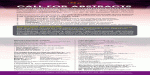


SHUNGU NAMUTITIMA INTERNATIONAL FILM FESTIVAL (SHUNAFFoZ) 2015
Vilole Images Productions is glad to invite filmmakers to submit documentaries, short films and full-length films to the Shungu Namutitima International Film Festival of Zambia (SHUNAFFoZ). The festival will run from Friday 21st to Saturday 29th August 2015 in Livingstone and from Wednesday 19th to Saturday 22nd August 2015 in Kabwe. Deadline for submissions is Monday 22nd June 2015. Celebrating the 10th Anniversary, under the theme ''DARE TO DREAM, MAKE A DIFFERENCE'', the festival will accept Zambian and African films in competition. However, films from all over the world are for screenings ONLY. the 10th Anniversary will introduce another special award - the Artists Rights Award.
Read more
SHUNGU NAMUTITIMA INTERNATIONAL FILM FESTIVAL (SHUNAFFoZ) 2015
Vilole Images Productions (VIP) is glad to invite filmmakers to submit docuentaries, short films and full-length feature films to the Shungu Namutitima (Smoke That Thunders) International Film Festival of Zambia (SHUNAFFoZ). The festival will run from Friday 21st to Saturday 29th August 2015 in LIVINGSTONE and from Wednesday 19th to Saturday 22nd August 2015 in KABWE. Deadline for submissions is Monday 22nd June 2015. Celebrating the 10th Anniversary, under the theme ''DARE TO DREAM, MAKE A DIFFERENCE'', the festival will accept Zambian and African films for competition. However, films from all over the world are for screening only. The 10th anniversary will introduce another special award - the Artists Rights Award
Read moreFeatured Video
Visitors Counter


|
Today | 128 |

|
Yesterday | 1858 |

|
This week | 1986 |

|
Last week | 10247 |

|
This month | 5326 |

|
Last month | 44630 |

|
All days | 626767 |
Your IP: 54.173.35.129
,
Today: Dec 04, 2017