SHUNAFFoZ (Festival) 2012
- 1
- 2




Zambian films that won international awards in 2025
Zambian cinema spent much of the past decade building quietly, festival by festival, short film by short film. In 2025, that steady work paid off in a very loud way. Five feature-length and short productions from the Southern African nation picked up prizes at festivals and competitions across four continents, putting Lusaka on the map for global film programmers who had previously overlooked the country.
The wins were spread across genres and formats. Documentaries, narrative features, and experimental shorts all found juries willing to look beyond Hollywood and Bollywood for fresh storytelling. Critics from Cairo to São Paulo, and yes, from Sydney and Melbourne too, took notice. The films tackled subjects as varied as traditional music, urban migration, and the lives of women in the copper mining belt.
For audiences in Australia, this is an exciting moment. SBS and ABC programming teams have long championed African cinema, and recent years have seen more Zambian titles on Australian streaming platforms. Viewers in Adelaide, Perth, and Brisbane can now stream several of these award winners on platforms like SBS On Demand or catch them at community screenings organised by African diaspora associations in suburbs like Footscray or Parramatta. It is a fair dinkum shift in what local audiences can access, and one that Australian film lovers have been waiting for.
Vilole Images Productions (VIP) has been central to this surge. Through its year-round development programmes and the annual Shungu Namutitima International Film Festival of Zambia (SHUNAFFoZ), the organisation has created a pipeline that takes a filmmaker from script to global premiere. The five films below all passed through that pipeline in some form, and they showcase the breadth of stories coming out of the country right now.
Mwamba's Echo: a documentary resonates with global audiences
Directed by a collective of Lusaka-based filmmakers, Mwamba's Echo took the Best Documentary prize at the Durban International Film Festival in mid-2025. The film follows three traditional musicians across Zambia's Eastern Province as they preserve rhythms that were nearly lost during the urban migration waves of the 1990s.
The documentary weaves concert footage with oral histories, allowing elders to speak directly to camera about the role of music in mourning, courtship, and seasonal farming. The score itself is built almost entirely from field recordings. For Australian viewers accustomed to documentaries narrated in a Western style, the film's patience and refusal to rush is striking, and its visual palette of red earth and dry grasslands feels both specific and universal.
The film also sparked conversations about how indigenous sound is treated in cinema. The use of traditional instruments in film scoring is gaining recognition globally, and Mwamba's Echo demonstrates how authentic soundscapes can carry narrative weight without orchestral bombast. Those interested in the technical side can read more about Zambian film soundtracks and how local composers are approaching the craft.
The Copperbelt takes centre stage in Berlin
Written and directed by a filmmaker who grew up in Kitwe, The Copperbelt premiered at the Berlinale in February 2025 and walked away with the Silver Bear for Best Screenplay. The film is a multigenerational drama centred on a family running a small catering business near a mine in the Copperbelt Province, and it unfolds over a single election week.
What makes the film remarkable is its refusal to reduce the region to a single narrative. Rather than telling a story of extraction and exploitation alone, the script focuses on the women who keep the local economy running while the men travel to the mines. The dialogue mixes Bemba and English with a rhythm that feels entirely natural, never forced, and the food preparation scenes are shot with the same care as the political discussions.
Australian critics were quick to champion the film when it screened at the Sydney Film Festival later in the year. Local reviewers compared it to the social realism of Ken Loach and the family dramas of Asghar Farhadi, and several noted that it offered a perspective rarely seen in Western media. The film is expected to get a limited theatrical release in Australia through a distributor that specialises in African cinema.
Luangwa wins the short film Oscar
In the most high-profile win of the year, the short film Luangwa took the Academy Award for Best Live Action Short Film at the 2025 ceremony. The fifteen-minute film follows a young anti-poaching ranger in the South Luangwa National Park who discovers a snare set by a former classmate now working for a poaching syndicate.
The film was produced on a micro-budget, with much of the wildlife footage captured by camera traps operated by the actual park service. The director, who is based in Mfuwe when not working on projects, drew on her own childhood growing up near the park. The result is a film that feels grounded in a specific place rather than constructed for international appeal, and its tension builds slowly through silence and landscape.
The Oscar win sent ripples through the Australian film industry as well. Several Sydney-based producers reached out to Zambian counterparts about potential collaborations, and there is talk of a co-production fund being established between Screen Australia and African film bodies. Filmmakers curious about the mechanics of such deals can explore resources on securing international co-production deals to understand how cross-border partnerships actually work in practice.
Nkwazi brings Zambian animation to Annecy
For the first time, a Zambian animated film won a prize at the Annecy International Animation Festival. Nkwazi, a twelve-minute hand-drawn short about a mythical eagle that loses its ability to fly, won the Junior Jury Prize in the short film category.
The animation style draws from Tonga and Bemba visual traditions, using geometric patterns and earth-tone palettes that distinguish it from the typical Disney or Studio Ghibli aesthetic. The story itself is a fable about community and humility, told without dialogue, relying instead on movement and a percussive soundtrack that uses kalimba and drums.
The film has screened at numerous family-friendly events around Australia, including the Brisbane International Animation Festival and children's workshops at the Australian Centre for the Moving Image in Melbourne. Educators have noted its value as a teaching tool for cultural studies and visual literacy in primary schools, particularly for units on African art and storytelling.
Bemba: a quiet triumph at Cannes
The fifth major win of 2025 came at the Cannes Film Festival, where the feature film Bemba received the Un Certain Regard prize for its poetic exploration of language and loss. The film follows a retired teacher in a remote village who refuses to stop teaching in Bemba despite government mandates to use English in schools.
Shot in long, contemplative takes over a six-week period in the Mbala district, the film is a meditation on cultural preservation and the politics of language. The lead performance by a non-professional actor was widely praised, and the film's cinematographer, who learned her craft at the Lusaka-based VIP film school, won the technical prize from the same festival's parallel section.
For Australians with an interest in linguistic diversity, the film resonates strongly. Australia is itself a multilingual society, and the film's themes about endangered languages strike a chord with First Nations communities and language revival movements across the continent. Screenings at the Melbourne International Film Festival sold out within hours, and there are plans for a national tour in 2026 organised through regional art centres.
How to watch and support these films
Australian viewers have several solid options for engaging with this new wave of Zambian cinema:
- Check SBS On Demand and ABC iview regularly, as both platforms have been adding more African content to their libraries throughout 2025 and often rotate titles seasonally
- Attend screenings at the Sydney Film Festival, Melbourne International Film Festival, and Brisbane Asia Pacific Film Festival, which all featured Zambian titles this year and often include director Q&A sessions
- Join mailing lists for African film collectives in your city, such as the African Film Collective in Melbourne or the Sydney African Film Festival, which run monthly screenings in community halls
- Support VIP directly through their website and consider submitting your own work to the Shungu Namutitima International Film Festival of Zambia (SHUNAFFoZ), which accepts submissions from filmmakers worldwide including those based in the Australian diaspora
- If you are a producer or investor, look into the Australia-Africa Film Initiative, a new fund supporting co-productions between the two regions with grants opening in early 2026
Ready to dive deeper into the world of Zambian cinema? Pop online and visit Vilole Images Productions at viloleimages.com to explore their catalogue, read interviews with the filmmakers behind these award winners, and find out how you can support the next generation of African storytellers. Whether you are a seasoned film buff, a curious student, or an industry professional looking for fresh talent, there has never been a better time to engage with the stories coming out of Zambia.
SHUNAFFOZ 2016 Entry Form

Featured Articles
- 1
- 2
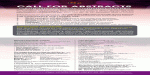


SHUNGU NAMUTITIMA INTERNATIONAL FILM FESTIVAL (SHUNAFFoZ) 2015
Vilole Images Productions is glad to invite filmmakers to submit documentaries, short films and full-length films to the Shungu Namutitima International Film Festival of Zambia (SHUNAFFoZ). The festival will run from Friday 21st to Saturday 29th August 2015 in Livingstone and from Wednesday 19th to Saturday 22nd August 2015 in Kabwe. Deadline for submissions is Monday 22nd June 2015. Celebrating the 10th Anniversary, under the theme ''DARE TO DREAM, MAKE A DIFFERENCE'', the festival will accept Zambian and African films in competition. However, films from all over the world are for screenings ONLY. the 10th Anniversary will introduce another special award - the Artists Rights Award.
Read more
SHUNGU NAMUTITIMA INTERNATIONAL FILM FESTIVAL (SHUNAFFoZ) 2015
Vilole Images Productions (VIP) is glad to invite filmmakers to submit docuentaries, short films and full-length feature films to the Shungu Namutitima (Smoke That Thunders) International Film Festival of Zambia (SHUNAFFoZ). The festival will run from Friday 21st to Saturday 29th August 2015 in LIVINGSTONE and from Wednesday 19th to Saturday 22nd August 2015 in KABWE. Deadline for submissions is Monday 22nd June 2015. Celebrating the 10th Anniversary, under the theme ''DARE TO DREAM, MAKE A DIFFERENCE'', the festival will accept Zambian and African films for competition. However, films from all over the world are for screening only. The 10th anniversary will introduce another special award - the Artists Rights Award
Read moreFeatured Video

Visitors Counter


|
Today | 128 |

|
Yesterday | 1858 |

|
This week | 1986 |

|
Last week | 10247 |

|
This month | 5326 |

|
Last month | 44630 |

|
All days | 626767 |
Your IP: 54.173.35.129
,
Today: Dec 04, 2017